
🌟 Introduction: When Pixels Meet Possibility
Not long ago, art was considered one of the last sacred human domains — a space where emotion, intuition, and lived experience couldn’t be replicated by machines. Then came Midjourney, DALL·E, and Stable Diffusion, and suddenly anyone could type “a fox astronaut painting the stars” and receive a gallery-worthy image in seconds. 🦊🚀
This sparked one of the biggest debates of our digital age: Is AI a creative partner or an artistic executioner?
In this article, we dive deep into the world of the AI artist — exploring the fear of replacement, the power of collaboration, and
where the future of creativity is truly headed. Buckle up! 🎢
🖌️ What Exactly Is an “AI Artist”?
The term AI artist can mean two different things — and understanding the difference is key to this debate:
- 🤖 The AI as the artist — Generative models that create images, music, or writing from text prompts using machine learning.
- 🧑🎨 The human using AI — Artists, designers, and creators who incorporate AI tools into their workflow to sketch, iterate, and produce work faster.
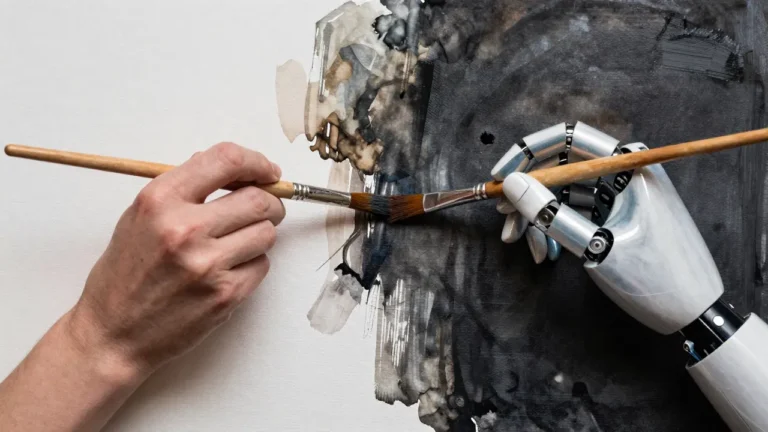
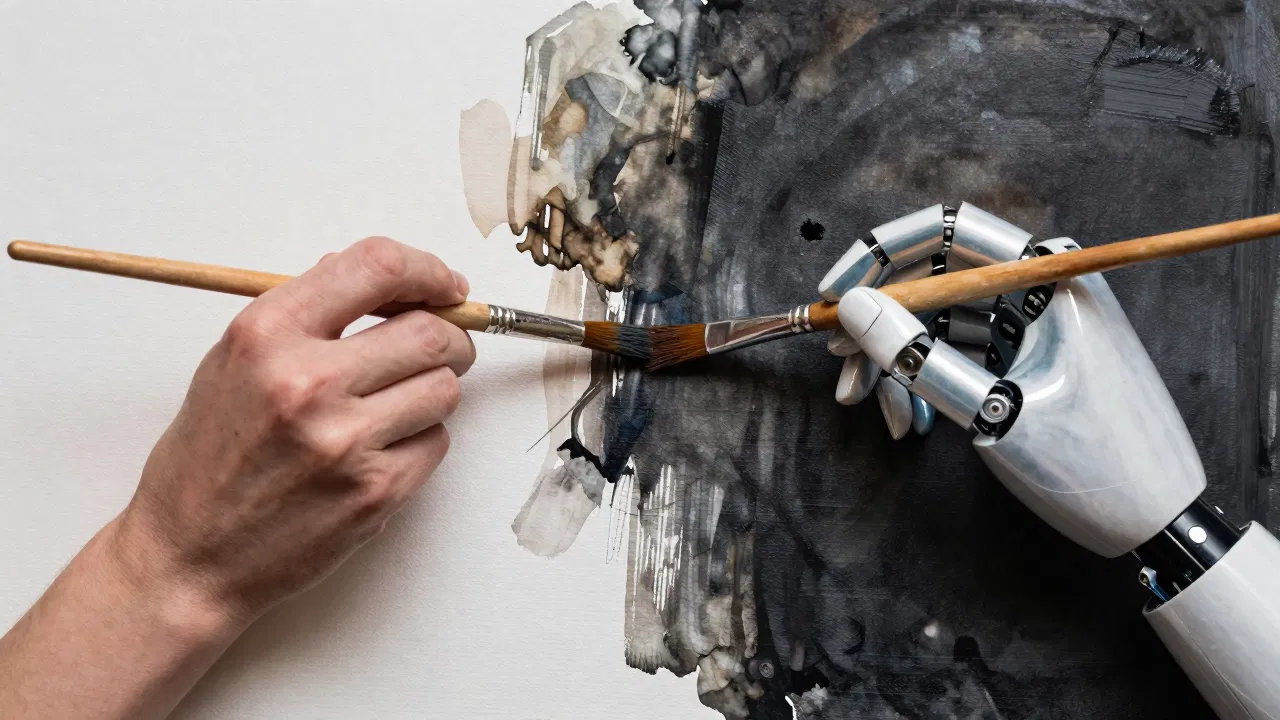
In reality, the most compelling AI-assisted work today sits somewhere in between — a human-machine creative partnership where the person provides vision, taste, and intent, while the AI provides speed, variation, and scale.
⚡ The Rise of Generative AI in Creative Industries
The creative world has been transformed at a staggering pace. Consider what’s already possible:
- 🎨 Image generation — Tools like Midjourney and DALL·E 3 produce hyper-realistic or stylized visuals from simple prompts
- 🎵 Music composition — Platforms like Suno and Udio can generate full songs, vocals included
- 📝 Writing & storytelling — LLMs draft scripts, poems, and even entire novels
- 🎬 Video production — AI video tools like Runway and Sora are reshaping filmmaking
- 🎮 Game design — Developers generate textures, character concepts, and environments on the fly
What once required years of training — illustration, 3D modeling, sound design — can now be prototyped in minutes. That’s both thrilling and terrifying, depending on which side of the canvas you’re standing on. 😅
😰 The Fear: “Will AI Replace Artists?”
Let’s be honest — this fear is valid. It’s not paranoia; it’s economics.
Why artists are worried:
- 💼 Job displacement
— Illustrators and graphic designers have already reported losing
commissions to clients who chose “good enough” AI images at a fraction
of the cost. - 💰 Devaluing creative work — When thousands of images can be generated for free, the perceived value of human-made art drops.
- ⚖️ Training data controversies — Many models were trained on artists’ work without consent or compensation, leading to ongoing lawsuits and ethical battles.
- 🔄 Market flooding
— Stock platforms and freelance marketplaces are being inundated with
low-effort AI content, making it harder for original creators to stand
out.
💡 The uncomfortable truth: Some roles will be automated. But history suggests the full story is more nuanced — and far more interesting.
🤝 The Case for Collaboration: AI as a Creative Superpower
Here’s the counterpoint: AI is a tool, and tools rarely kill creativity — they redefine it.
When photography was invented, painters feared extinction. Instead, Impressionism was born.
When digital art emerged, traditionalists scoffed — today, digital
artists are among the most celebrated creators on Earth. 🖥️✨
How AI is empowering artists right now:
- 🚀 Speeding up ideation — Generate 50 concept variations in minutes, then refine the best one by hand
- 🧠 Breaking creative blocks — AI suggestions can spark directions you’d never have imagined
- 🎯 Democratizing creation — People without formal training can finally express their visions visually
- ⏱️ Eliminating grunt work — Let AI handle backgrounds, resizing, and variations while you focus on the signature details
- 🌍 Expanding accessibility — Artists with disabilities are using AI to create in ways previously impossible
The pattern across every creative revolution? The artists who embrace new tools don’t disappear — they level up. 💪
⚔️ AI vs. Human Creativity: A Quick Comparison
| Aspect | 🤖 AI Creativity | 🧑🎨 Human Creativity |
|---|---|---|
| Speed | Seconds to minutes | Hours to months |
| Originality | Recombines learned patterns | Draws from lived experience & emotion |
| Intent & Meaning | None — it predicts patterns | Deep personal & cultural context |
| Iteration | Infinite variations instantly | Deliberate, thoughtful refinement |
| Emotional Resonance | Simulated, often surface-level | Authentic and deeply relatable |
| Consistency | Tireless and scalable | Limited by time & energy |
| Ethical Judgment | Absent | Central to the process |
The takeaway? AI excels at execution and exploration; humans excel at meaning and intention. The strongest creative work uses both. 🧩
🏆 Real-World Examples of Human + AI Collaboration
The collaboration model isn’t theoretical — it’s already winning awards and audiences:
- 🎥 Filmmakers use AI for storyboarding, pre-visualization, and VFX prototyping before committing expensive shooting days
- 📚 Authors co-write with LLMs to brainstorm plots and overcome writer’s block — then infuse the final draft with their unique voice
- 🎨 Concept artists at major studios use Midjourney and Stable Diffusion to explore visual directions in hours instead of weeks
- 👗 Fashion designers generate pattern variations with AI, then bring the best concepts to life with traditional craftsmanship
- 🎵 Musicians use AI stems and voice tools as instruments — a new synthesizer, not a new composer
These creators aren’t being replaced by AI. They’re being amplified by it. 📈
🛠️ How Artists Can Thrive in the AI Era
Want to stay relevant (and profitable) as an AI artist or creative professional? Here’s your roadmap:
- 🧭 Own your vision — AI can generate images, but it can’t decide what’s worth making. Taste and curation are the new superpowers.
- 🎓 Learn the tools — Prompt engineering, ControlNet, fine-tuning, and inpainting are genuine skills worth mastering.
- ✍️ Develop a signature style — Mass-produced AI content all starts to look the same. Distinctive human perspective stands out more than ever.
- 🔗 Build direct audience relationships — Fans follow people, not prompt outputs. Newsletters, communities, and personal brands are your moat.
- ⚖️ Stay informed on ethics & copyright — Understand licensing, disclosure, and emerging regulations (like the EU AI Act) to protect your work.
- 🎨 Blend mediums
— The hybrid workflow — AI drafts + hand refinement, digital +
traditional — produces work that’s both efficient and unmistakably
human.
🗝️ Key insight: In an age where anyone can generate an image, the story behind the image becomes the real product.
🔮 The Future: Not Replacement — Redefinition
So, will AI replace artists? The most realistic answer: AI will replace tasks, not artists — and it will redefine what “artist” means.
Think of it this way:
- The camera didn’t kill painting — it freed painters from photorealism
- Synthesizers didn’t kill musicians — they created entire new genres
- AI won’t kill creativity — it will shift the creative value from technical execution to imagination, curation, and human connection
The artists who treat AI as a collaborative instrument
— like a brush, a camera, or a synth — will shape the next creative
renaissance. Those who ignore it risk falling behind those who don’t. 🌅
The choice isn’t human vs. machine. It’s human + machine vs. yesterday’s limits. 🚀
❓ Frequently Asked Questions (FAQ)
Q1: Can AI-generated art be considered “real” art?
Yes — courts, museums, and major art competitions increasingly recognize AI-assisted works as art. The debate is really about authorship and process, and that conversation is still evolving. 🏛️
Q2: Do I need artistic training to use AI art tools?
No technical training is required to start — but understanding
composition, color theory, and design fundamentals dramatically improves
your results. AI lowers the entry barrier, not the quality ceiling. 🎯
Q3: Is AI art legal to use commercially?
It depends on the tool and platform. Most major generators grant
commercial rights to outputs, but copyright status varies by country and
ongoing litigation. Always check the license and consider disclosing AI
use. ⚖️
Q4: What are the best AI art tools for beginners?
Midjourney (stunning aesthetics), DALL·E 3 (ease of use inside ChatGPT),
Stable Diffusion (open-source control), and Adobe Firefly (commercially
safe training data). 🛠️
Q5: How can artists protect their work from AI scraping?
Options include Glaze and Nightshade (anti-mimicry tools), opting out of
training datasets where possible, watermarking, and supporting
legislation like the proposed updates to copyright law. 🛡️
💬 Final Thoughts: The Brush Is New, The Soul Is Yours
The story of the AI artist isn’t a tragedy about replacement — it’s a choose-your-own-adventure about collaboration.
AI brings speed, scale, and surprise; humans bring meaning, taste, and
heart. Together, they’re painting a future neither could create alone.
🌈
So, are you team collaboration or worried about replacement? Drop your take in the comments below — we read every one! 👇
And if you found this article valuable, share it with a creative friend and subscribe to AITechStart.com for more sharp insights on the AI revolution. 🔔
🏷️ Tags:
AI artist, AI art, generative AI, creative collaboration, AI art tools,
Midjourney, DALL·E, Stable Diffusion, will AI replace artists, future
of creativity, AI and artists, human vs AI creativity, AI tech blog,
artificial intelligence
⚠️ Disclaimer: This
article was published on AITechStart.com. Some parts of this article —
including drafts of certain sections, structural suggestions, and
illustrative examples — were generated with the help of artificial
intelligence and subsequently reviewed and edited by our editorial team.
While we strive for accuracy, AI-generated content may contain errors
or outdated information. All views expressed are for informational
purposes only and do not constitute professional, legal, or financial
advice.